
How Much Does a Website Cost in Pakistan? A Practical Breakdown
What you actually pay for when you build a website in Pakistan: domain, hosting, design, content and upkeep, plus how to compare quotes without getting burned.
Ask five developers in Pakistan what a website costs and you will hear five very different numbers. One freelancer quotes a price that sounds too good to be true, an agency quotes ten times more, and a friend says you can do it yourself for almost nothing. None of them is necessarily lying. They are quoting for different things.
This guide breaks a website down into the parts you actually pay for, explains what pushes each part up or down, and gives you a checklist for comparing quotes so you can spend the right amount for your business, not the lowest or the highest.
In this article
The fixed costs every website has
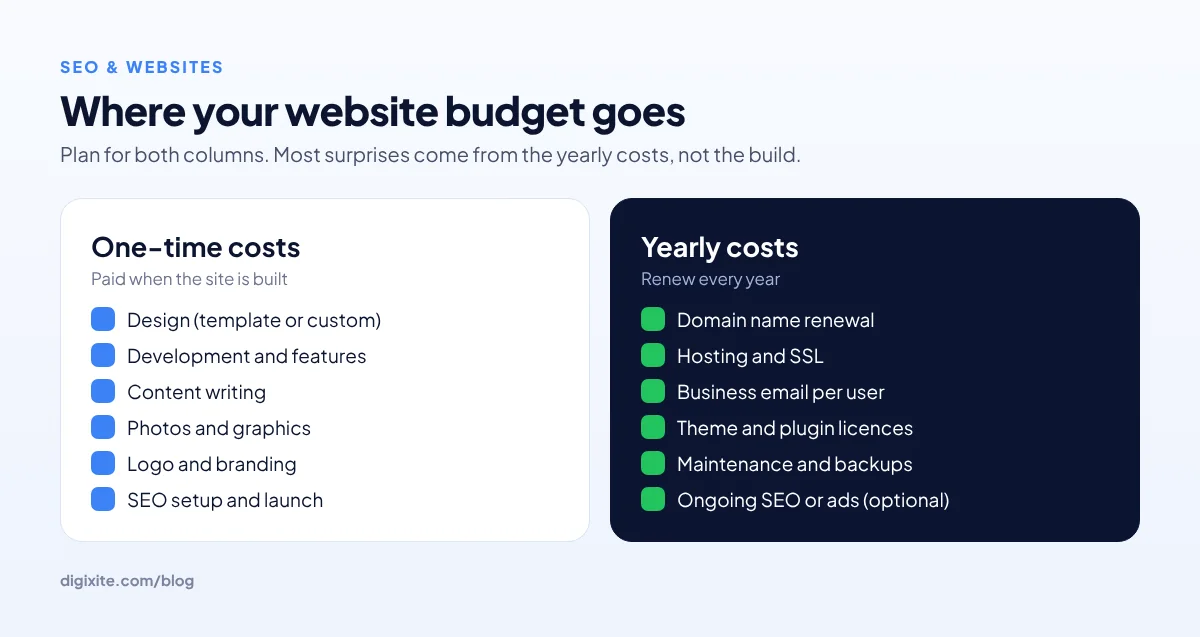
Some costs exist no matter who builds your site. They are small, but they recur every year, so they belong in your budget from day one.
Domain name
Your domain is your address online. You can choose a global ending such as .com or a Pakistani one such as .pk or .com.pk. A local ending signals that you serve Pakistan; a .com is better if you also sell abroad, for example to the UAE, UK or North America.
The .pk registry, PKNIC, publishes its own fees. At the time of writing, its payment page lists Rs. 2,100 per year for registrants in Pakistan, charged in two-year blocks. Resellers and hosting companies may add their own margin or bundle the domain with hosting. Global domains are sold by many registrars, and the renewal price often differs from the first-year offer, so always check what year two will cost.
Hosting
Hosting is the server that stores your site and sends it to visitors. You will usually choose from shared hosting (cheapest, fine for most small business sites), a VPS or cloud server (more power and control, needs someone to manage it) or a hosted platform such as Shopify or Wix, where hosting is included in a monthly subscription.
What matters more than the plan name is where the server is, how fast it responds, whether daily backups are included, and whether SSL (the padlock) is free. A slow host quietly costs you customers; our guide to Core Web Vitals explains why speed affects both visitors and Google.
Business email
An address like info@yourbusiness.pk looks far more trustworthy than a free webmail address. Some hosting plans include mailboxes; otherwise, Google Workspace and Microsoft 365 charge per user per month. Budget for every person who needs their own inbox.
Design and development: where the real price difference is
This is the part that varies most, because it is mostly people's time. Four things decide how much time is needed.
1. The type of website
| Type | Typical use | What drives effort |
|---|---|---|
| One-page or brochure site | Showing services, contact details and location | Number of pages, design quality, copywriting |
| Business website (5 to 15 pages) | Service companies, clinics, schools, consultants | Page count, forms, WhatsApp and map integration, SEO setup |
| E-commerce store | Selling products online with cart and checkout | Product count, payment gateway, courier integration, stock management |
| Web platform or portal | Bookings, memberships, CRM, dashboards | Custom features, user accounts, testing, security |
2. Template or custom design
A ready-made theme adapted to your brand is quicker and cheaper. A custom design, planned around your customers and drawn from scratch, takes longer but usually converts better and looks unlike your competitors. Many good projects sit in the middle: a solid theme or framework with a custom home page and key landing pages.
3. The platform
WordPress itself is free and open source, which is one reason it is so common in Pakistan, but premium themes, plugins and their yearly licences are not. Hosted builders like Shopify and Wix replace a large build fee with a monthly subscription plus app fees. A fully custom-coded site has no licence fees and is usually the fastest, but changes need a developer. Choose based on who will update the site and how fast it needs to be, not only on the first invoice.
4. Features that add time
- Online payments. Connecting a local gateway, bank or wallet takes setup, merchant approval and testing.
- Cash on delivery and couriers. Very common in Pakistan, but syncing orders with a courier's system is extra work.
- Bilingual content. An English and Urdu site needs right-to-left layout support and double the content.
- Bookings, memberships or logins. Anything with user accounts needs more security and testing.
- Integrations. CRMs, ERPs, WhatsApp Business, Google Analytics and ad tracking.
Tip: Write a one-page list of exactly what the site must do before you ask for quotes. Quotes become comparable, and you avoid paying for features you will never use.
The costs people forget
Most budget surprises come from these items, not from the build itself.
- Content. Someone has to write the pages, and good copy sells. If you supply it yourself, plan the time; if not, budget for a writer.
- Photos. Real photos of your shop, team or products beat stock images. A short professional shoot is often worth it.
- Logo and branding. If you have no proper logo, colours or fonts yet, that is a separate design job.
- SEO setup. Basic on-page SEO (titles, descriptions, sitemap, speed, Google Search Console) should be part of any build. Ongoing SEO to rank for competitive terms is a separate monthly service.
- Google Business Profile. Free to create, and for local businesses in cities like Lahore it often brings more calls than the website itself.
- Maintenance. Updates, backups, security monitoring and small edits. An unmaintained WordPress site is a common target for hackers.
- Renewals. Domain, hosting, email, theme and plugin licences all renew yearly. Some are priced in dollars, so rupee costs can change with the exchange rate.
Freelancer, agency or do it yourself?
Do it yourself
Website builders make a simple site possible without code. This works for a personal brand or a very small shop if you have time and a good eye. The hidden cost is your hours, and DIY sites often miss the basics of speed, SEO and mobile layout.
Freelancer
A skilled freelancer can be excellent value for a clearly defined project. Check their portfolio by visiting live sites they built, ask who will handle updates and emergencies after launch, and make sure the domain and hosting are registered in your name, not theirs.
Agency
An agency costs more because you get a team: designer, developer, content and SEO, plus project management and continuity if one person leaves. It makes most sense when the website is central to your sales, you need several skills at once, or you plan to run ads and SEO afterwards.
How to compare quotes fairly
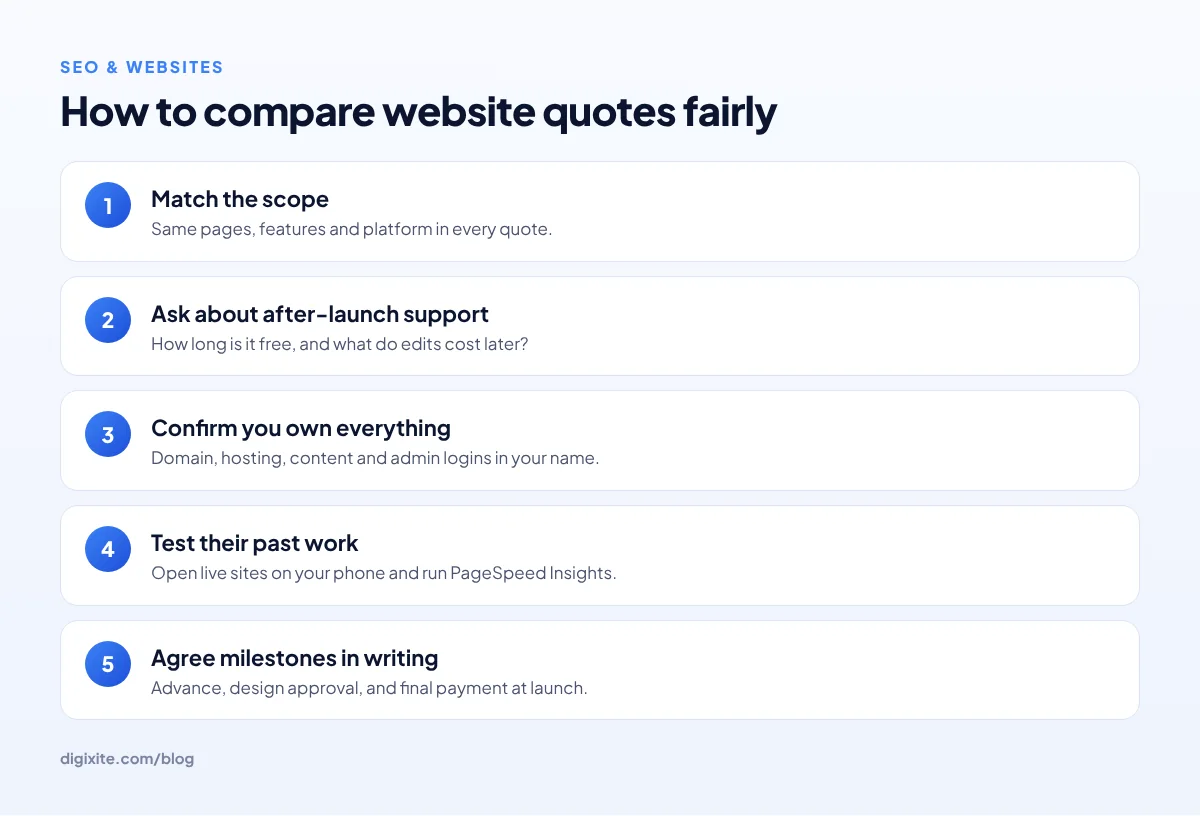
- Compare the same scope. Same number of pages, same features, same platform. A cheap quote often leaves out content, SEO or revisions.
- Ask what is included after launch. How long is free support? What do edits cost later?
- Confirm ownership. You should own the domain, the hosting account, the content and the design files, with admin logins handed over.
- Check speed and mobile. Open their past projects on your phone. Test a few with Google's free PageSpeed Insights.
- Get payment milestones in writing. A common pattern is an advance, a payment on design approval and the rest at launch.
- Ask about yearly running costs. A good provider will tell you upfront what renews and roughly when.
Warning: Be careful with very low quotes that use pirated ("nulled") premium themes or plugins. They often contain malware and cannot be updated safely, which can get your site hacked and your domain flagged by Google.
Quick checklist before you spend
- Know the goal: calls, WhatsApp enquiries, bookings or online sales.
- List the pages and features you truly need now, and what can wait for phase two.
- Budget for the yearly costs: domain, hosting, email, licences and maintenance.
- Decide who writes the content and who takes the photos.
- Keep the domain and hosting in your own name.
- Compare at least three quotes for the same scope.
- Plan how people will find the site: Google Business Profile, SEO, social media or ads.
A website is not a one-off purchase but a small business asset with running costs. Budget for the whole life of the site, not just the launch, and you will rarely be surprised. If you would like a second opinion on a quote or your current site, Digixite offers a free website and SEO audit.