Choosing a Web Design Agency in Dubai: What to Check Before You Sign
A practical checklist for hiring a web design agency in Dubai: licences, portfolios, Arabic support, ownership, contracts, SEO and the red flags to walk away from.
Dubai has no shortage of web design agencies. A quick search brings up hundreds, from one-person studios to large teams with offices in Business Bay, and their quotes for the same website can differ by ten times or more. Most of them will show you beautiful mock-ups. Far fewer will tell you who owns your domain when the project ends, or what happens to your Google rankings when they replace your old site.
This guide gives you a practical way to compare agencies before you sign anything. It covers the checks that matter in the UAE specifically, from trade licences and VAT invoices to Arabic layouts and data protection, plus the contract terms and red flags that separate a good partner from an expensive mistake.
In this article
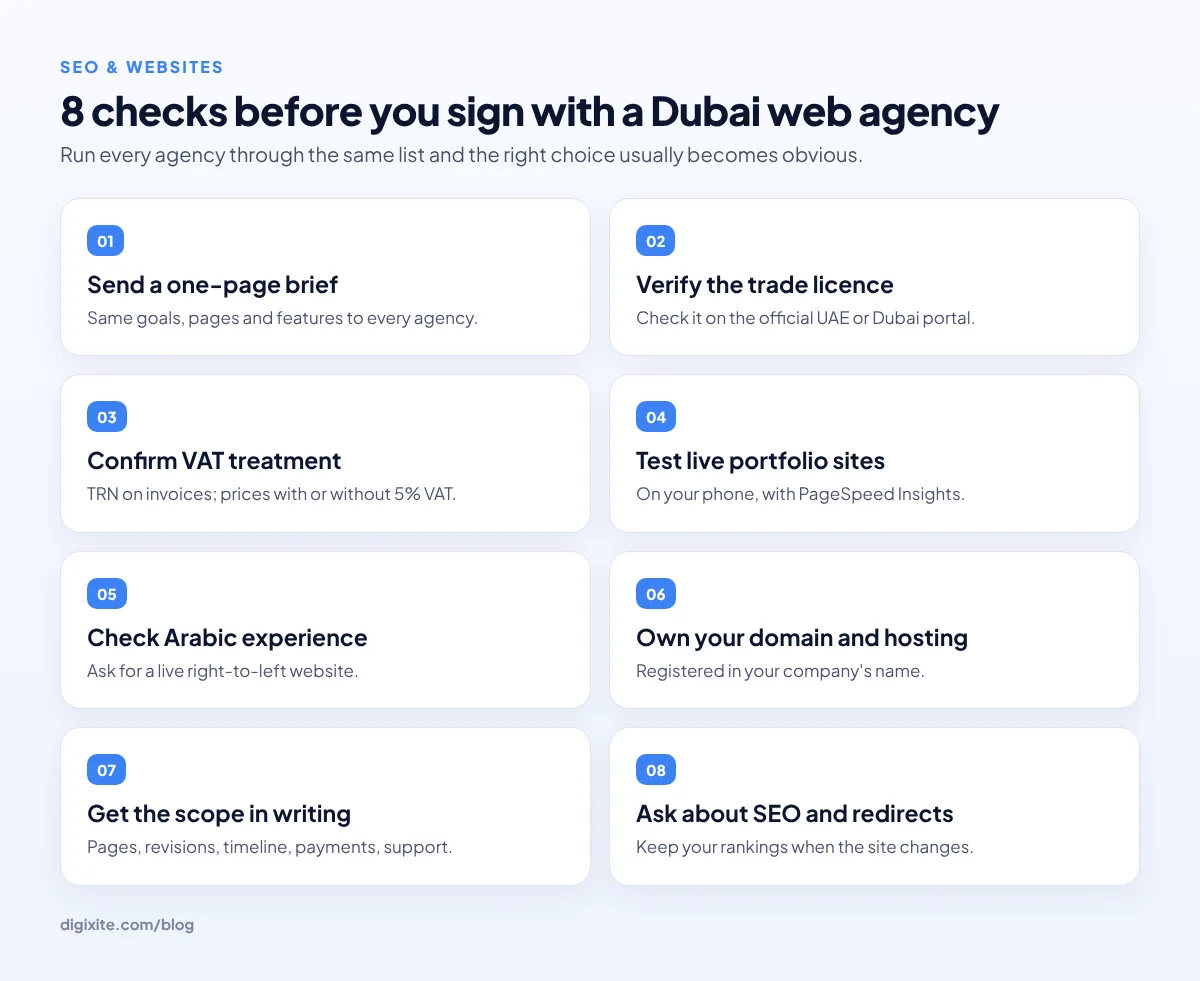
Start with a one-page brief
Before you contact anyone, write down what the website must do. Agencies quote very differently for a vague request, and a short brief is the fastest way to make quotes comparable.
- The goal. Enquiries, WhatsApp chats, bookings, online sales or investor leads.
- The pages and features. For example: home, services, about, contact, a blog, property listings or an online store.
- Languages. English only, or English and Arabic from day one.
- Who updates it. If your team will edit content, the platform and training matter more than the design.
- Budget and deadline. A realistic range helps agencies propose the right solution instead of guessing.
Send the same brief to three to five agencies and ask each for a written proposal. You will learn as much from how they respond as from the price.
Check the agency is real and properly set up
Trade licence
Any company providing services in the UAE should hold a valid trade licence, whether on the mainland or in a free zone. Ask for the licence number and check it yourself. The UAE government portal lists the official places to verify business licences, including Dubai Economy and Tourism for Dubai companies. Make sure the licensed activity covers web design or IT services and that the company name matches the one on your contract.
VAT and invoices
If the agency is registered for VAT, its tax invoices should show its Tax Registration Number (TRN) and the 5% VAT separately. This matters if your own business is VAT-registered and wants to reclaim the tax. Ask upfront whether prices are quoted with or without VAT, so you compare quotes on the same basis.
Who actually does the work
Many Dubai agencies work with designers and developers in other countries, which is perfectly normal and often good value. What matters is transparency. Ask who will design and build your site, who your day-to-day contact is, and what time zone they work in.
Judge the portfolio, not the pitch
A portfolio of screenshots proves very little. Ask for links to live websites and check them yourself.
- Open them on your phone. Most visitors in the UAE will see your site on mobile first.
- Test the speed. Run a few through Google's free PageSpeed Insights. Slow sites lose visitors and rank lower; our guide to Core Web Vitals explains the scores.
- Look for your industry. A real estate site, a clinic and an online store each need different features. Experience in your sector saves time and mistakes.
- Check Arabic work. If you need Arabic, ask to see a live right-to-left site. A proper Arabic version is much more than translated text; menus, forms and layouts all need to mirror correctly.
- Ask for references. A short call with one or two past clients tells you how the agency handles deadlines and problems.
Make sure you will own everything
This is where many business owners get caught out. The website should belong to you, not to the agency.
- Domain name. Register it in your company's name, with your own login at the registrar. This applies whether you use a
.comor a.aedomain. - Hosting account. Ideally in your name too, or at least with full admin access and the ability to move it.
- Website logins. Administrator access to the site itself, not just an editor account.
- Design and content. The contract should transfer the rights to the design, code and content to you once you have paid in full.
Warning: Be careful if an agency registers the domain in its own name or will only host the site on its own servers with no way to leave. If the relationship ends, getting your own website back can become slow, expensive or impossible.
UAE-specific details to discuss
Arabic and bilingual sites
Decide early whether you need Arabic. Adding it later usually costs more than planning for it from the start, because the layout, menus and SEO structure all change.
Payments and enquiries
If you will take payments online, ask which payment gateways the agency has integrated before and whether they support AED. For enquiry-based businesses, make sure WhatsApp, click-to-call and forms send leads straight to your team.
Privacy and data protection
The UAE has a federal Personal Data Protection Law (Federal Decree-Law No. 45 of 2021), while the DIFC and ADGM free zones have their own data protection rules. According to Chambers' 2026 UAE guide, the federal law's implementing regulations had not yet been issued, so ask your legal adviser what applies to you. Practically, your website should have a clear privacy policy, collect only the data it needs and handle cookie consent sensibly. A good agency will raise this without being asked.
Read the proposal and contract carefully
A professional proposal should spell out:
- The exact pages, features and integrations included.
- How many rounds of design changes you get.
- A timeline with milestones, and what the agency needs from you (content, photos, approvals) to meet it.
- Payment stages, typically an advance, a payment on design approval and the balance at launch.
- What happens after launch: how long support lasts, what it covers and what later changes cost.
- Yearly running costs: hosting, domain renewal, licences and maintenance.
When comparing quotes, line them up against your brief. The cheapest quote often leaves out content, SEO setup or post-launch support, which you then pay for separately. Our breakdown of what a website really costs covers the parts that are easy to forget.
Ask about SEO before, not after
A new website should be built to be found. Ask every agency how they handle page titles and descriptions, site speed, mobile layout, and a sitemap submitted to Google Search Console. If you are replacing an existing site, ask how they will redirect old pages so you keep your current Google rankings. An agency that cannot answer this clearly may cost you traffic you have spent years building.
For local businesses, ask whether they can also set up or improve your Google Business Profile. In a competitive market like Dubai, the map results often bring more calls than the website itself.
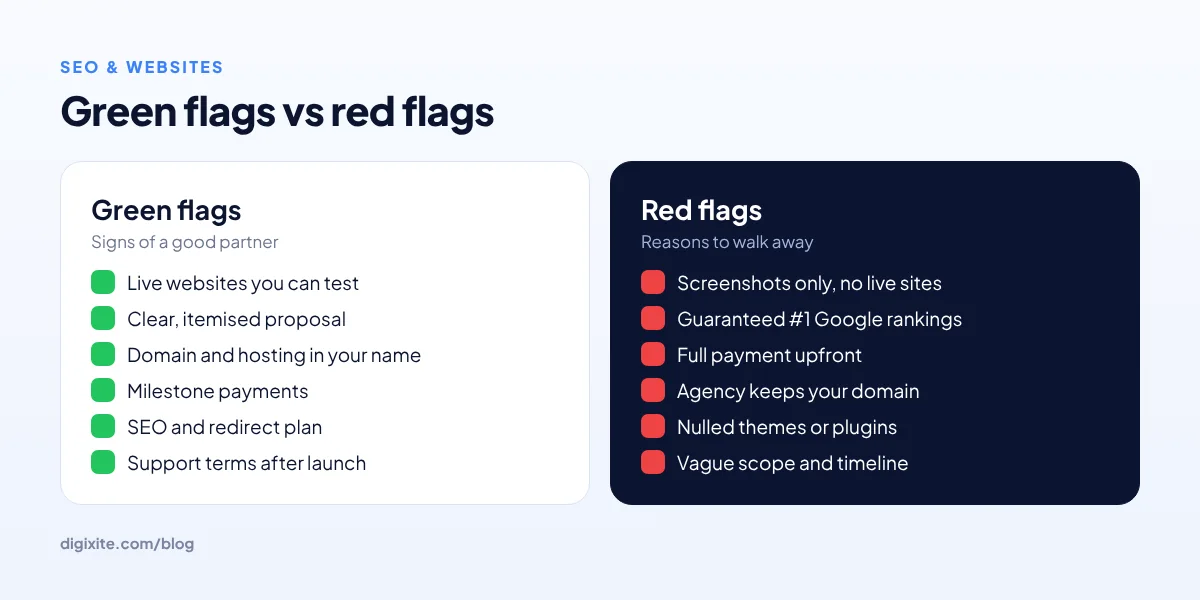
Red flags to walk away from
- Very low prices with no clear scope, or a full website promised in a couple of days.
- No live websites to show, only screenshots or templates.
- Guaranteed "number one on Google" rankings. No one can honestly promise that.
- Pressure to pay everything upfront.
- Reluctance to put the domain and hosting in your name.
- Pirated ("nulled") premium themes or plugins, which often contain malware.
Quick checklist before you sign
- A one-page brief sent to every agency, so quotes are comparable.
- Trade licence verified, and VAT treatment confirmed.
- Live portfolio checked on mobile, including Arabic work if you need it.
- Domain, hosting and admin logins in your name.
- Scope, revisions, timeline, payment stages and support written into the contract.
- A clear plan for SEO, redirects and Google Business Profile.
- Privacy policy and data handling discussed.
Choosing well takes a little more time upfront, but it saves far more later. If you are planning a website in the UAE, our Dubai page shows the work we have done for local businesses, and Digixite offers a free website and SEO audit if you would like a second opinion on a proposal.