Selling Online in Pakistan: Payment Gateways, COD and Marketplaces Compared
How Pakistani customers really pay online, how COD, wallets, cards and Raast compare, and when to sell on a marketplace versus your own store.
Online shopping in Pakistan has grown fast, but selling online here still works differently from most other countries. Many customers want to see the parcel before they pay, many have a mobile wallet but no credit card, and a big share of orders still arrive through Instagram and WhatsApp rather than a checkout page.
This guide compares the main ways to take payment, cash on delivery, mobile wallets, cards and the State Bank's Raast system, and looks at when it makes sense to sell on a marketplace and when to build your own store. The aim is to help you set things up so more orders turn into delivered, paid sales.
In this article
How Pakistanis actually pay online
Two things are true at the same time. Digital payments are growing quickly, and cash on delivery is still the default for many shoppers.
- The State Bank of Pakistan's Payment Systems Review for July to September 2025 recorded 250 million online e-commerce payments worth PKR 343 billion, with wallets and bank accounts making up 94% of them by volume and cards only a small share.
- At the same time, a nationally representative Gallup & Gilani Pakistan survey reported by Dawn found that six out of ten respondents preferred cash on delivery when shopping online. Fear of fraud, poor dispute resolution and inconsistent delivery quality are among the reasons people hold back from paying in advance.
The practical lesson is simple: offer cash on delivery, but make paying online so easy and trustworthy that more customers choose it.
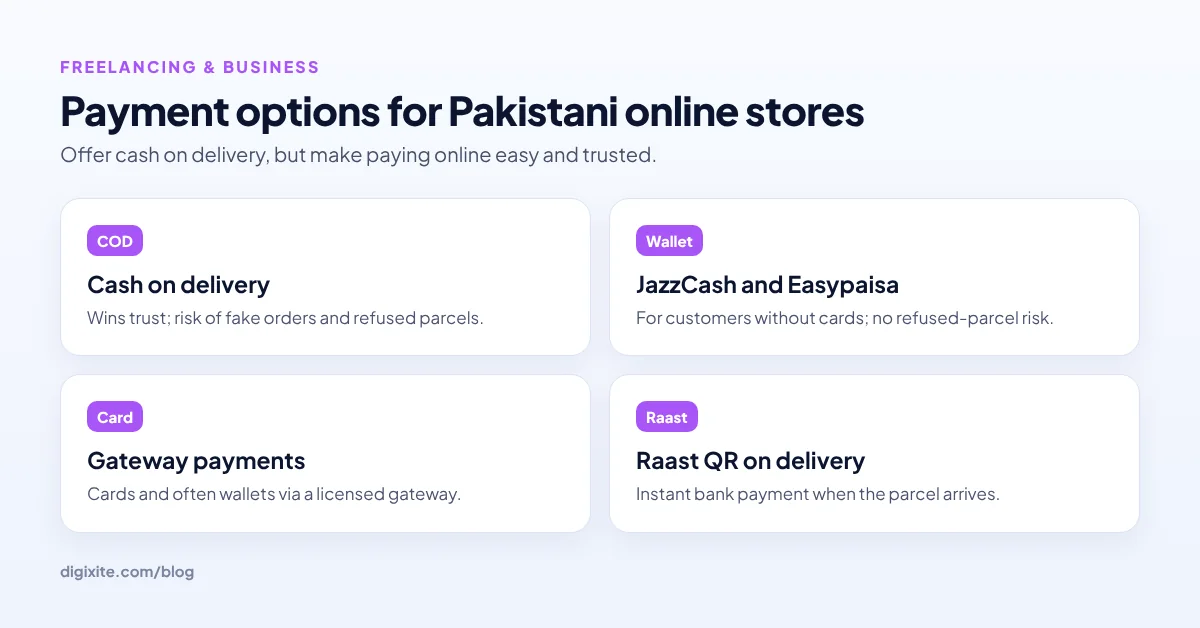
Your payment options compared
Cash on delivery (COD)
Good for: winning first-time customers who do not yet trust your brand. The catch: fake orders, refused parcels and returns cost you two-way shipping, and you wait for the courier to send you the collected cash.
To reduce losses, confirm every COD order before dispatch by WhatsApp or a call, watch for repeat refusers, and consider a small advance payment for high-value or custom items.
Mobile wallets (JazzCash, Easypaisa)
Good for: customers who do not have a debit or credit card but use a wallet every day. Wallet payments can be offered through a gateway at checkout or as a payment link sent on WhatsApp. They usually settle faster than COD and remove the risk of refused parcels.
Card payments through a gateway
Good for: higher-value orders and customers who prefer cards. Pakistani payment gateways such as PayFast, Safepay and the banks' own gateways can accept cards and often wallets too. Payment gateways need a licence from the State Bank; Dawn reported that SafePay received its commercial licence as an e-commerce payment gateway during FY25. Check fees, settlement time and how refunds work before you sign.
Raast QR payments
Raast is the State Bank's instant payment system, and its person-to-merchant (P2M) service lets businesses receive payments instantly. When the SBP launched it, it gave a useful example for online sellers, reported by Dawn: a merchant can print a QR code on the delivery package so the customer scans and pays when the parcel arrives. That gives you the trust of "pay on delivery" without handling cash. The SBP has also told merchant service providers that customers must not be charged a fee for these payments.
Tip: Small nudges move customers from COD to online payment: faster dispatch, free delivery or a small discount for paying online. Show trusted payment logos and a clear refund policy at checkout.
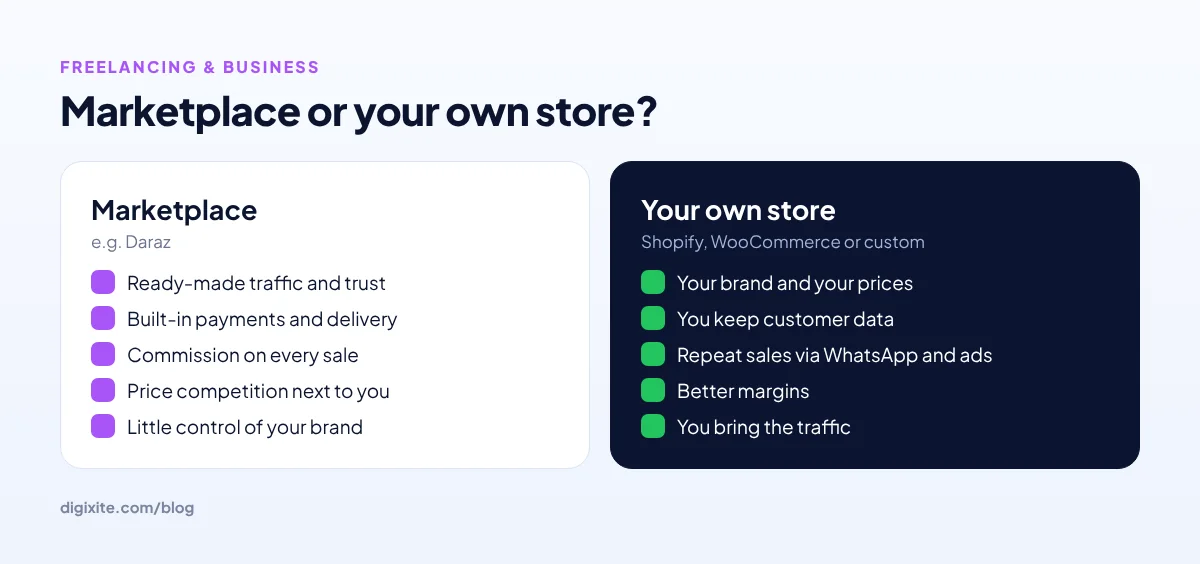
Marketplace or your own store?
Selling on a marketplace
Marketplaces such as Daraz bring ready-made traffic, built-in payments and delivery, and buyer trust. They are a good way to test products or reach customers outside your city. The trade-offs are commissions and fees on every sale, strong price competition with sellers listed right next to you, strict rules, and little control over your brand or customer relationships.
Your own online store
Your own store, on Shopify, WooCommerce or a custom build, keeps your brand front and centre. You control pricing, design and the checkout, keep your customer data, and can build repeat sales through WhatsApp, email and retargeting ads. The trade-off is that you must bring the traffic yourself through social media, Google and word of mouth. If you are choosing a platform, our comparison of Shopify vs WooCommerce covers the costs, including the extra fee Shopify charges when you use a third-party gateway (Shopify's own payment processor is not available in Pakistan).
The common answer: both
Many successful Pakistani brands use a marketplace for reach and discovery, and their own store and social media for brand building and repeat customers, where margins are better.
Delivery and couriers
Your courier is part of your customer experience. Choose one that covers the cities you sell to, offers reliable COD collection and quick cash settlement, and has tracking your customers can follow. Courier booking and tracking can be connected to most store platforms through apps or plugins, which saves your team from typing every address by hand.
Be clear about delivery times, charges and return rules on your website and in your WhatsApp replies. Unclear policies are a common cause of refused parcels.
Building trust so customers pay online
- Look like a real business: a proper website with your address, phone and WhatsApp number, not just an Instagram page.
- Show real reviews and photos of your products and packaging.
- Be clear about refunds and exchanges, and honour them quickly.
- Reply fast on WhatsApp. Many customers message before they buy.
- Keep your website fast on mobile data; most Pakistani shoppers are on their phones.
Common mistakes to avoid
Treating every COD order as a sale
An order is not a sale until the money reaches your account. Track your delivery success rate and the real cost of returned parcels, not just the number of orders. A product that looks profitable on paper can lose money once refusals and return shipping are counted.
Hiding the total price
Surprise delivery charges at the door are a common reason customers refuse parcels. Show the full price, including delivery, before the order is placed.
Running ads to a slow or confusing page
Paying for Instagram, TikTok or Google ads that land on a slow page, or on a page without a clear price and order button, wastes money. Fix the store first, then scale your ads.
Relying only on Instagram DMs
Taking every order by message works when you are small, but it does not scale and it loses customers who want to buy at night without waiting for a reply. A simple store with a proper checkout lets people order any time, and you can still keep WhatsApp for questions.
Quick checklist
- Offer COD, but confirm every order before dispatch.
- Add at least one wallet or gateway option so customers can pay in advance.
- Consider Raast QR payments on delivery as a cash-free alternative.
- Decide your mix of marketplace and own store, and track margins for each.
- Pick a courier with good coverage, tracking and fast COD settlement.
- Publish clear delivery, refund and exchange policies.
- Make the store fast, mobile-friendly and easy to trust.
We have built Shopify stores for many Pakistani brands, and you can see some of them on our Shopify store development page or our Lahore page. Digixite also offers a free website and SEO audit if you would like a second opinion on your store.